I recently interviewed Kate Driscoll, an amazing art teacher at Richmond Primary School in East Fremantle, Western Australia, for my Youtube series Tips from Teachers Sewing with Kids.
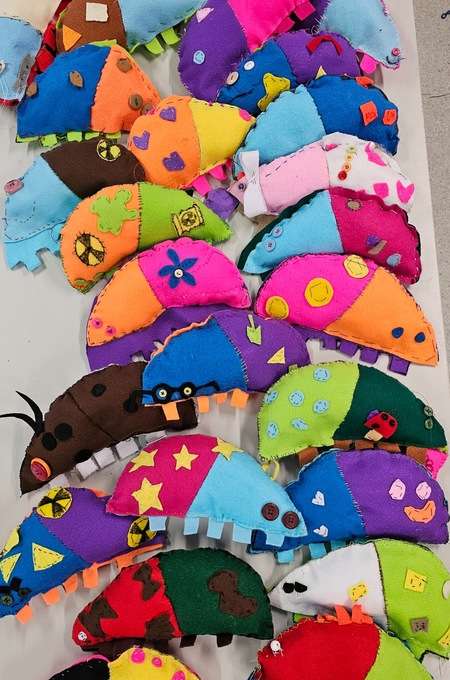
I’ve been following Kate for years on Instagram, and I love everything she does with her students. She has participated in Global Kids Sewing Party with her classes, and some of her students were pattern testers for Billy Bug in my Sew a Softie Workbook 1.
One of the things I really love about Kate’s approach is that she encourages her students to design their own projects. She introduces her students to contemporary, often Australian, artists and gets them to develop their own designs inspired by that artist’s unique style.
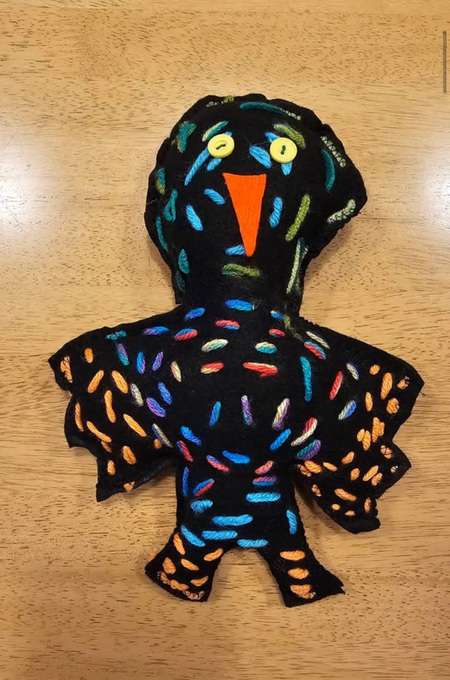
For one project, Kate showed her young students a video about the Yarrenyty Arltere Artists demonstrating how they dye old blankets using gum leaves and rusted metal before turning them into soft expressively-stitched sculptures. Kate got her students to use black felt as the background fabric to echo the dark blankets used by the Yarrenyty Arltere artists and to enhance the colourful stitching of their designs. It was a lovely example of how she introduces her students to new artists and their art making processes and then gives them space to imagine something all their own.

Helping children become independent
“My aim with the kids is autonomy” Kate says, and she’s not just speaking about creative autonomy.
She wants her students to know where to find their supplies, how to use them and how to put them away. A cupboard at the back of the classroom holds the textile equipment, so the children know where everything belongs and know that they are responsible for finding, using and stowing their stuff. (Go Kate!).
And rather than cutting everyone’s yarn in advance, Kate places a piece of tape on several desks to mark a manageable length and her students then measure their yarn from the edge of the desk to the piece of tape and cut it themselves.
It’s a simple idea that gives children another part of the art making process that they can manage all by themselves.

Peer tutoring
This is another of Kate’s teaching practices that I really love.
If several students have mastered a skill, Kate gets them to help classmates who may still be struggling with it. This allows her to focus her energies where they are most needed, nurtures responsibility and co-operative interactions amongst students, and fosters a shared creative environment. It seems a wonderfully vibrant way to learn.
And she has a very pragmatic three-help limit which I also love: children can only ask another student for help three times. This means that they realise that they have to pay attention to their chosen student tutor and watch carefully so they can then do it themselves, rather than become reliant on someone they see as more competent to do the work for them.


What surprised Kate about sewing with her students
Kate teaches a wide range of art making but she appreciates and values the slowed-down pace of sewing. Children can sit together, talk together and casually help one another while they continue sewing.
Some children who don’t feel confident painting or drawing can discover something they really connect with in sewing. She also said that she was surprised by how much some of her rough-and-tumble boys really got into the sewing, including some who found it difficult to concentrate on other activities in the classroom. As Kate observed, “Seeing what they’ve made can help them believe in themselves .”
And for some students, that interest definitely continues beyond classes at school. Parents have emailed telling Kate how their kids insisted they buy sewing supplies so they could keep sewing during the holidays.
In our chat together, Kate also talks about the supplies she likes to use, about different materials she gets her students to sew onto such as photos on card, onto paintings and onto screen prints, as well as sharing her chant“Up Wrap Pull” for teaching blanket stitch. It was a really interesting and instructive interview.
You can find Kate on Facebook and Instagram as Art Teacher Life.